
What it is
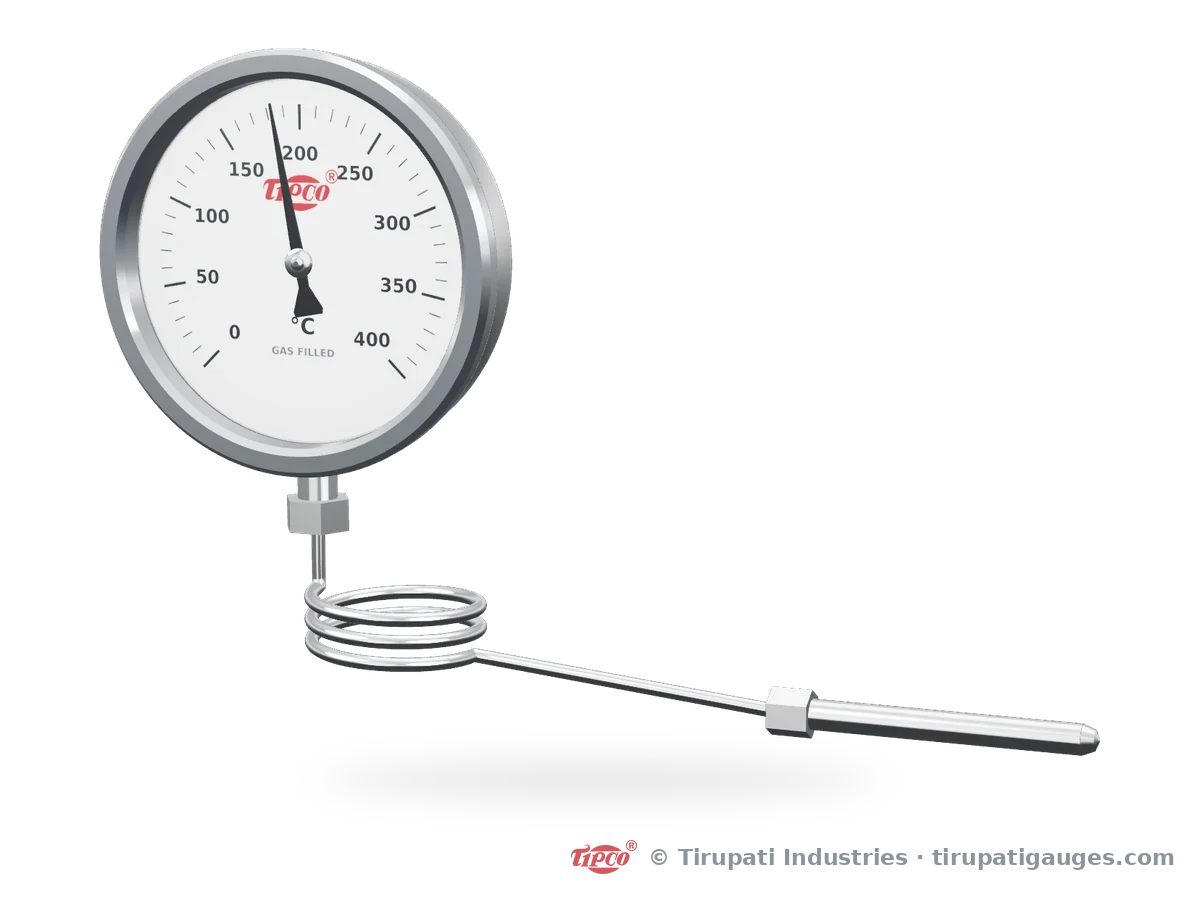
A gas-filled temperature gauge has a sensing bulb, a capillary tube and a dial, sealed as one system and filled with an inert gas. The capillary lets you mount the dial on a panel or in a convenient place, away from the hot or hard-to-reach point.
The capillary is protected by a flexible armour, in the length your installation needs.
How it works
As the bulb warms, the gas inside expands and its pressure rises. The pressure travels up the capillary to a Bourdon tube in the case, which turns the pointer.
Where it is used
- Panel and remote reading
- Engines, compressors and generators
- Ovens, dryers and furnaces
- Cold rooms and refrigeration
- Machines with vibration at the measuring point
Things to consider
- Tell us the capillary length and how it will be routed.
- Choose the bulb size and connection to suit the process.
- Avoid sharp bends or crushing of the capillary.
- Use a thermowell for points under pressure or flow.
What to tell us for a quote
- Temperature range
- Dial size and stem length (or capillary length)
- Connection and thread size
- Need for a thermowell
- The medium and its working pressure
- Quantity
Questions about gas-filled temperature gauges
Why choose a gas-filled thermometer over a bimetal one?
When the dial must be read away from the measuring point, or the point has vibration or is hard to reach. The capillary carries the reading to wherever the dial is mounted.
Can the capillary be cut or shortened?
No. The bulb, capillary and dial are one sealed system, so the length is fixed when it is made. Tell us the length you need.
Not sure this is the right gauge?
Answer up to 5 quick questions and the Gauge Finder suggests the right one from our range.
Need gas-filled temperature gauges?
Send us the range, medium and connection and we will quote.