
What it is
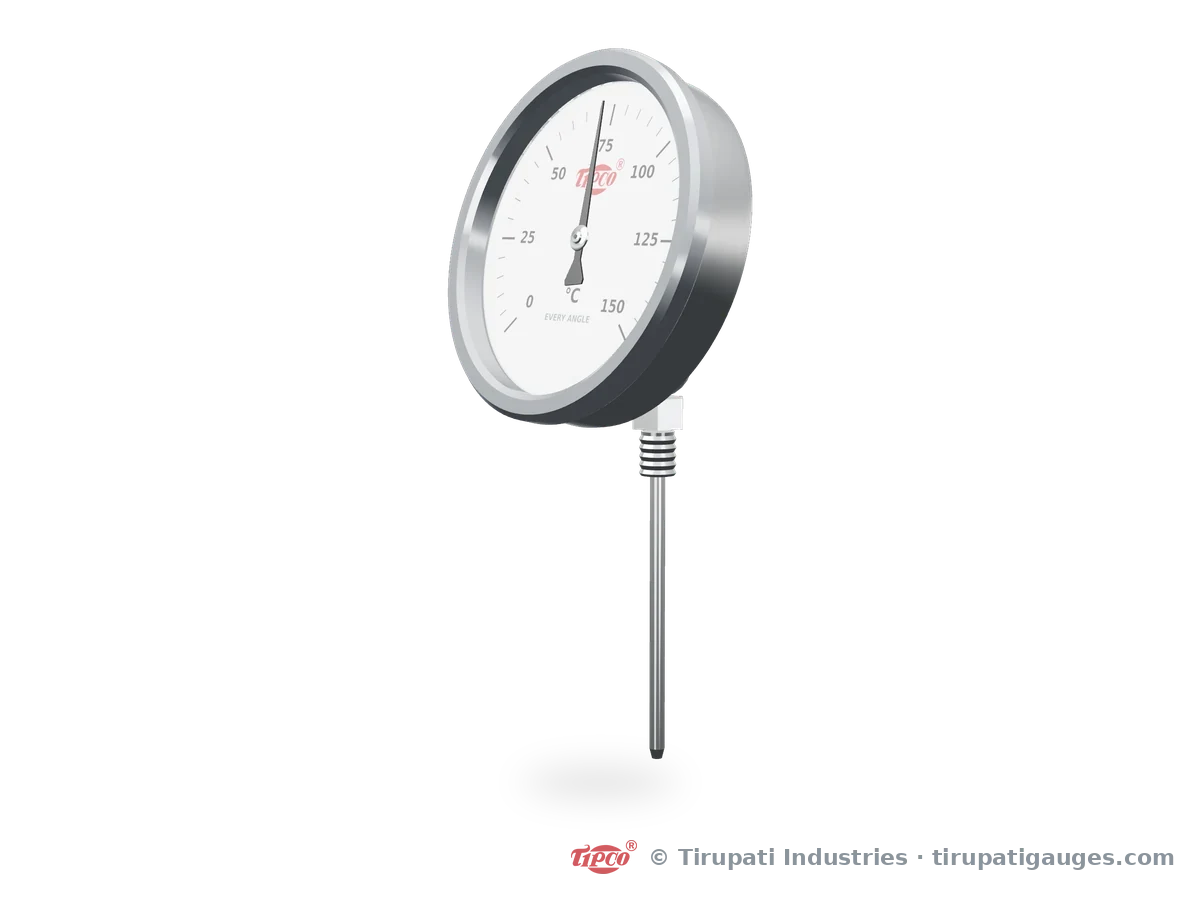
An all-angle temperature gauge, also called an every-angle thermometer, has a swivel joint between the stem and the case. After installation, the head can be turned and tilted so the dial faces the operator.
It is ideal where pipes and vessels are fitted at awkward angles.
How it works
A bimetal coil in the stem turns as the temperature changes, and the rotation is carried through the swivel joint to the pointer. A lock nut holds the head in the chosen position.
Where it is used
- Pipes and vessels at awkward angles
- Crowded skids and plant rooms
- HVAC, boilers and hot water
- Process lines where the dial must face a walkway
Things to consider
- Choose the stem length so the sensing part sits in the flow.
- Use a thermowell for points under pressure or flow.
- Set the head angle after installation, then tighten the lock nut.
What to tell us for a quote
- Temperature range
- Dial size and stem length (or capillary length)
- Connection and thread size
- Need for a thermowell
- The medium and its working pressure
- Quantity
Questions about all-angle temperature gauges
What is an every-angle thermometer?
A bimetal thermometer whose head turns and tilts on a swivel joint, so the dial can face the operator whatever the mounting position.
Not sure this is the right gauge?
Answer up to 5 quick questions and the Gauge Finder suggests the right one from our range.
Need all-angle temperature gauges?
Send us the range, medium and connection and we will quote.